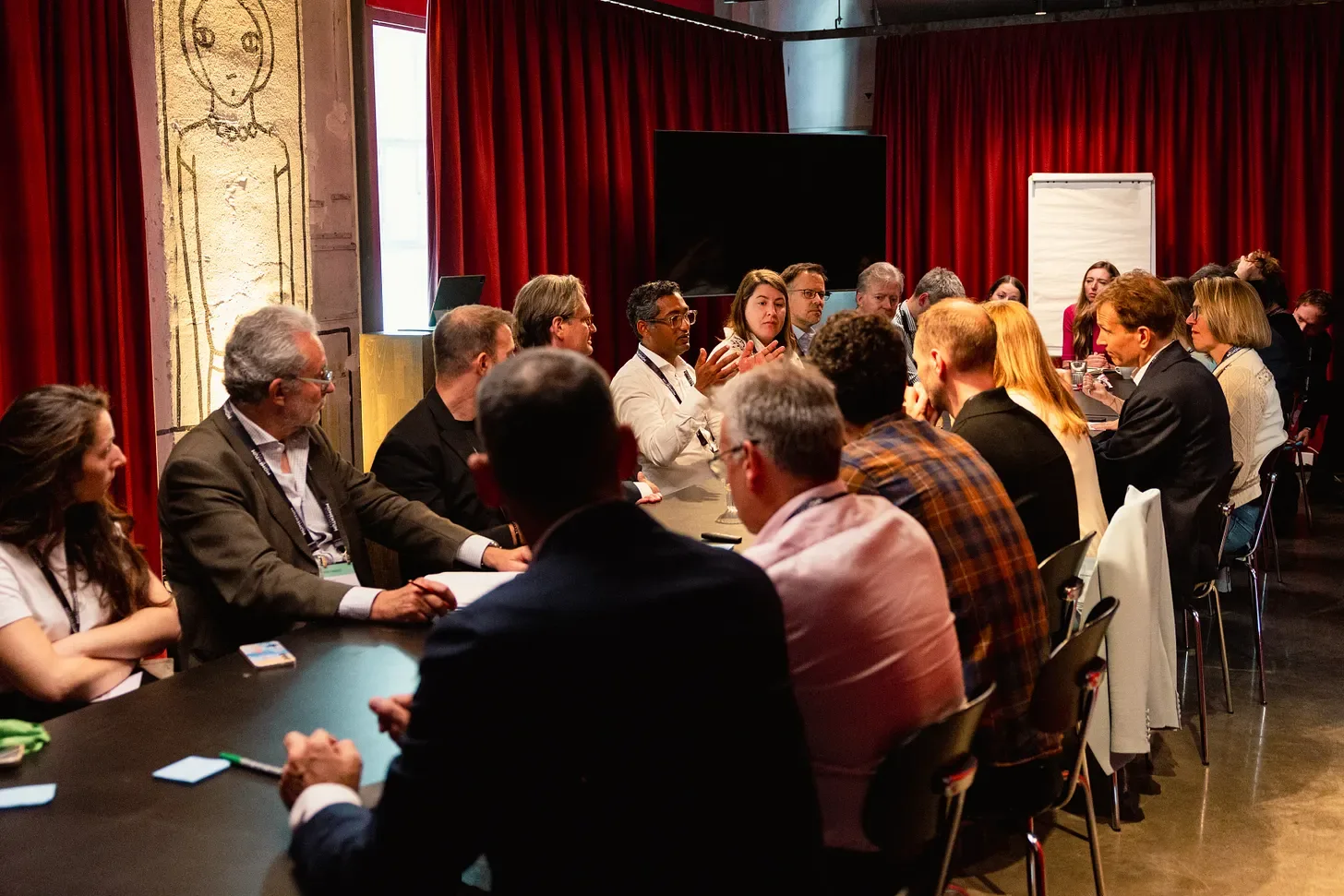
On the 8th of May 2026, a closed-door conversation in Zürich brought together investors, foundation principals, and operators from across the nature and biodiversity space to take apart the conventional model of nature finance. The conversation was hosted by Wyss Academy for Nature, in collaboration with Amazonia Impact Ventures and Innpact, and anchored by a live case from the Peruvian Amazon. It produced one of the sharpest diagnostic moments of The Decision Room Edition I, an event that brought together more than 160 decision-makers representing over $100 billion in assets under management.
This essay starts from that conversation, then builds outward. The diagnosis and the core argument are what the room produced. The supporting detail, the named companies, the figures, the policy context, comes from research conducted afterward to test and extend what was said. Where a claim is attributed to "a participant" or "the room," it reflects something said in the conversation. Everything else is verified independently. It is for investors, founders, philanthropic principals and operators who have run out of patience with the gap between intention and outcome.
It argues four things.
One. Nature finance, in its current form, is misdescribed as a portfolio problem when it is in fact a value-chain problem.
Two. Concentration across a single value chain de-risks each node and the system, while conventional diversification protects no one in nature.
Three. The standard 2/20 fund management model is structurally incompatible with the unit economics of impact in the Global South.
Four. With public first-loss capital retreating, the natural replacement is philanthropic and family-office capital, but only if it is reframed as catalytic rather than expendable.
The wrong question
For most of the last decade, the central question in nature finance has been some version of: how do we make capital flow to nature? It is the wrong question. It assumes the problem is supply. It assumes that if enough capital is mobilised, enough projects will be funded, and enough projects will deliver.
The evidence from the room said the opposite. The problem is not supply. The problem is structure. The pipes are leaking. The instruments are mismatched. The timelines are wrong. And the dominant model of how to deploy capital into nature, borrowed wholesale from conventional asset management, is producing the outcome it was always going to produce: capital pooled in the institutions that can absorb it, not in the ground.
The conversation did not produce a manifesto. It produced a diagnosis. And it produced a counter-thesis to the way nature finance is conventionally structured.
The leakage
A participant in the conversation offered a number that stopped the room. Less than 0.02% of capital pledged for nature reaches on-the-ground projects in the Global South. The figure is contested and the methodology behind it is not in the public record. But its directional claim is unarguable.
To understand why, consider how a typical commitment travels. A government, a foundation, or a multilateral announces a billion-dollar pledge for nature finance. The pledge flows to a development finance institution, which absorbs the overhead, the staffing, and the structuring costs. A layer is taken. The DFI deploys what remains through a fund of funds. Another layer is taken. The fund of funds allocates to managers, who take 2% per year on assets under management regardless of outcome, and 20% of any upside they generate. Another layer. The managers deploy into projects sized to absorb their cheques, which means projects sized at $5 million and above. Projects below that threshold, which is most projects in most landscapes, are structurally invisible to this capital. The architecture is real even if no single commitment maps exactly to this path. Each layer is doing what it was incentivised to do. The cumulative effect is what the 0.02% figure points at.
This is not a bug. This is the system working exactly as designed.